Production Process
Nine steps from
clay to your wall
Every tile you order begins in the clay quarries of Fez and passes through nine stages of handwork before it reaches you. Understanding this process helps you plan your project — and appreciate what you are actually buying.
Clay Preparation
The journey begins in the clay quarries surrounding Fez — the only source used in authentic zellige. Once harvested, the raw clay is transferred to large mixing basins, combined with water, and worked until a perfectly smooth, homogeneous paste is formed.
The clay then rests for at least 48 hours. This is not optional. It allows the clay to reach consistent moisture content — which determines how cleanly it will cut and how evenly it will fire.

Clay sourced exclusively from the quarries of Fez, mixed until homogeneous and rested 48 hours before shaping.
Sun Drying & Moulding
The rested clay is pressed into rectangular wooden moulds measuring 10 cm × 20 cm (4″ × 8″). These bricks are laid out in the sun to dry for several days. The rate of drying depends on temperature and humidity — which is why production output varies seasonally.
Sun drying removes moisture at a rate that preserves structural integrity, preventing the micro-cracking that occurs with forced drying.
Clay pressed into 4″×8″ wooden moulds, dried naturally in the Moroccan sun over several days.
Forming the Tile
Once dried, the clay bricks are hand-cut into the two primary formats that define our range:
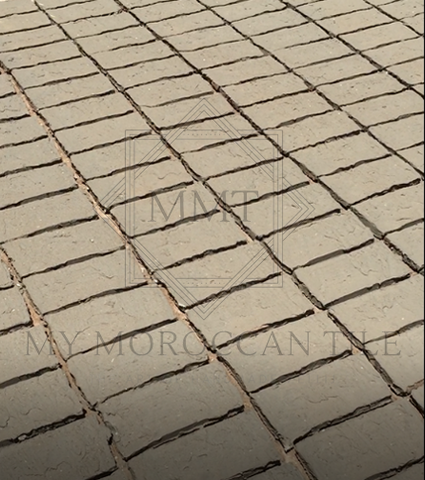
5 cm × 15 cm (2″ × 6″) — the terracotta format, for pavers, bejmat subway tiles, and floor tiles.
10 cm × 10 cm (4″ × 4″) — the zellige format, the base unit from which all our hand-cut ceramics and mosaics are made. Every star, hexagon, diamond, and geometric shape starts here.

Two formats: 2″×6″ terracotta bricks and 4″×4″ zellige squares. Everything we make begins with these.
First Firing
The formed tiles are shade-dried again to remove all remaining surface moisture, then enter the kiln. The first firing starts at low temperature, gradually increasing until the clay body is fully vitrified.
This stage alone can take several days depending on kiln load. After the first firing, two product families emerge:

Traditional kiln firing — temperature controlled by the kiln master’s experience, not digital automation.

After the first firing: unglazed terracotta and unglazed zellige. Both can be sold at this stage or continue to glazing.
Glazing
Glazing is where colour is created. Our artisans hand-mix mineral oxide pigments — copper for greens and teals, cobalt for blues, iron for terracottas and reds, manganese for purples — into a glaze base. Each batch is slightly different. That variation is the signature of the handmade.
Tiles are glazed using traditional dip-glazing — each piece submerged by hand. This creates depth and movement in the glaze surface that spray or roll-application cannot replicate.
For custom colour orders, we produce a control sample for your approval before full production begins.

Each tile submerged by hand in mineral oxide glaze. The depth of colour is created in this moment.
Second Firing
After glazing, tiles are stacked face-to-face and loaded into the beehive kiln for a second firing that sets the glaze permanently and develops the characteristic depth and luminosity of authentic zellige.
The kiln master reads the fire by sight and experience. There are no digital controls. Temperature and duration determine the final quality of the glaze.

Stacked inside the traditional beehive kiln. Temperature controlled by eye, not by dial.
Hand Cutting
This is the step that defines zellige. Using a maalem (chisel) and a small hammer, each glazed tile is hand-cut into its finished shape — squares, diamonds, stars, hexagons, triangles, lozenges, and complex interlocking geometric pieces.
The cut is made against the unglazed face, fracturing the clay precisely along the intended line. The slight imprecision of the hand creates the bevelled edges and varied joint widths characteristic of authentic zellige. No machine can replicate this.
A master cutter (maalem ezzellij) trains for 3–5 years before working production tiles.

Hand-cutting with chisel and hammer. The bevelled edge created by the fracture is what gives zellige its light-catching quality.
Mosaic Assembly
Individual cut pieces are assembled face-down onto a pattern template. Each piece is fitted by hand — selected for colour consistency, adjusted if needed, and set into the complete composition before backing.
We offer three assembly formats:
Loose tile: Individual cut pieces shipped flat. Installer assembles on site. Most economical; requires experienced zellige installation.
Standard interlocking panels (8″–18″): Pre-assembled for most tile patterns. Panels interlock edge-to-edge on site, reducing installation time 40–60%.
Custom fitted assembly (24″–36″): Panels pre-cut to your exact room dimensions in our factory. Each panel numbered and labelled. Installer places them in order — no mosaic experience required. Adds up to 8 weeks to production.

Assembly in our Fez workshop. Pieces laid face-down onto a pattern template, selected by eye for colour consistency.
QC, Packing & Shipping
Before packing, every order is inspected by our quality control team. Pieces that do not meet standard are pulled and remade — not shipped. This is what the Zellige de Fès certification requires.
We coordinate export documentation, customs clearance, and delivery scheduling directly.
Air freight (DHL): 5–10 business days from our factory.
Maritime freight: Approximately 6 weeks. Available for orders of 500 sq ft or more.

Each order inspected, cleaned, and packed before freight. We handle all export documentation from Morocco.
Three ways to receive your tile
Choose the format that suits your installer and project. All ship from our Fez factory. Custom dimensions available on request.
How long does it take?
All timelines depend on order type and factory schedule. We confirm your specific timeline at order placement. Plan for 12 weeks before your installation date.
| Order type | Production | Air (DHL) | Maritime | Lead time |
|---|---|---|---|---|
| Colour chip samples | Stock | Dispatched within 5 days | — | 1–2 wks |
| Mosaic samples | ~2 weeks | 5–10 days | — | 3–4 wks |
| Loose tile | 3–4 weeks | 5–10 days | ~6 wks (500+ sq ft) | 8–14 wks |
| Standard panels (8″–18″) | 4–6 weeks | 5–10 days | ~6 wks (500+ sq ft) | 10–16 wks |
| Custom fitted assembly (24″–36″) | Up to 8 weeks | 5–10 days | ~6 wks (500+ sq ft) | 14–18 wks |
| Custom colour order | 6–8 weeks | 5–10 days | ~6 wks (500+ sq ft) | 12–18 wks |
Ready to start your project?
Every order is quoted individually. Share your dimensions and we’ll reply with a price, a timeline, and a sample recommendation. Urgent? Call, text or WhatsApp +1 (619) 246-3109.